 |
| April Harr Blandin and Lewis Cleale in Passion at the Signature Theatre in VA in 1996 |
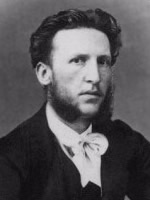 Born in 1839 in San Salvatore Monferrato, Italy, Iginio Ugo Tarchetti only lived to be twenty-nine years old. He served as a volunteer officer in the army from 1859 to1865 when he was discharged due to failing health. He spent the final years of his life in constant financial difficulty while writing for and founding many publications. Though his career as a writer was brief, it was prolific and Tarchetti would come to be known as part of a literary movement called the Scapigliatura -- literally translated as "the disheveled ones." Like the French bohemians, the Scapigliatura movement rebelled against conventional and accepted cultural norms, challenging Victorian romantic ideals in favor of an approach more like the new realism emerging in France.
 Between 1866 and 1869, Tarchetti would write his final novel. Apparently autobiographical, the work was a fictionalized account of affairs Tarchetti had with two women while still an officer, one a beautiful married woman named Clara, the other an epileptic cousin of one of his superiors, whose name was Carolina (or Angolina according to some sources). Tarchetti's tale of two very different romances epitomized his place as a member of the Scapigliatura, illustrating relationships which flauted social convention -- one adulterous, and one grotesque. In some respects, correlations can be seen between Tarchetti's work and that of Flaubert, the Brontes, and Rousseau.
"Fosca," as Tarchetti would call both the Carolina character and the novel in which she appears, was published in serialized form in the Milanese journal, Il Pungolo, but Tarchetti died from typhus before completing the final installment. A friend and fellow writer, Salvatore Farina, devised the ending which would ultimately be published.
Taking the Latin meaning of "Clara" as an adjective for "light," Tarchetti's renaming of Carolina was a pointed choice, the term "Fosca" being an archaic term for "dark." Unlike Fosca, the character in the novel, Carolina survived Tarchetti, and was said to send flowers to his grave every year on All Soul's Day, after his death.
Tarchetti would continue to be read in Italy throughout the 19th and 20th centuries, but Fosca would remain untranslated into English until over one hundred years after it was first published.
I realized that the story was not about how [Fosca] is going to fall in love with [Giorgio] (she's in love with him already, having watched him from a distance ever since his arrival) but about how he is going to fall in love with her. I was instantaneously upset (that is, moved) and at the same time thinking, "They're never going to convince me of that, they're never going to pull it off," all the while knowing they would, that Scola wouldn't have taken on such a ripely melodramatic story unless he was convinced that he could make it plausible. And he did.Other projects took precedence, however, and it would take another decade for Sondheim's initial ambition to turn Passione d'Amore into a musical to come to fruition.
After two successful collaborations with James Lapine in the 1980s, the Pulitzer-winning Sunday In the Park With George (1984) and the fairy-tale musical Into the Woods (1987), Sondheim had moved on to collaborate with his Pacific Overtures collaborator John Weidman on 1991's Assassins, but in looking for a new project to work on with Lapine, Sondheim offered Scola's film.
Lapine has since recounted that he was not initially taken with the property after seeing the film at Sondheim's request, but ultimately changed his mind when he read the novel. As Sondheim later noted in an interview in the fall of 1994 after the musical had opened on Broadway...
First of all, [the musical] is mostly based on the novel. The movie follows the novel quite closely but we really based our work on the novel, which has never been translated in English but which we got translated into in English, in a literal translation just for this purpose. The novel is quite discursive, and epistolary. It is all about letters, and it is all about discussions about various aspects of love. It's one of those 19th century novels with not a lot of action and a great deal of discussion.
Initially, the collaborators had concieved of a two-act musical consisting of two properties, one would be Passione d'Amore, the other would be a contemporary story about a man who changes his appearance through bodybuilding, entitled "Muscle" -- based on a memoir by Sam Fussell. Cultural preoccupations with appearance would be the link between the two pieces. However, after early attempts to adapt "Muscle," Sondheim abandoned the piece (which Lapine would later develop with another composer) and instead Sondheim and Lapine focused on a full-length musical adaptation of the Scola film and Tarchetti novel.
Under the film's title, Passione d'Amore, the musical was first staged in a closed workshop at Lincoln Center in October of 1993. The workshop's Clara and Fosca, Marin Mazzie and Donna Murphy respectively, would repeat their roles in the eventual Broadway production the following spring, while the roles of Giorgio, the Doctor, and the Colonel were played in the workshop by Peter Gallagher, Ron Rifkin and Simon Jones, but on Broadway those roles would be taken by Jere Shea, Tom Aldredge (who replaced William Duff-Griffin in previews), and Gregg Edelman.
Re-dubbed Passion for its Broadway appearance, 1994 musical was Sondheim's third Broadway property to open cold on Broadway with no previous tryout in front of an audience. Out-of-town tryouts, once a staple of the development process for new Broadway musicals, had waned in popularity in the 1970s and 1980s as production costs had spiraled upwards and other development models such as The Workshop had taken precedence. Up until 1979's Sweeney Todd, all the Broadway musicals Sondheim had written had received out-of-town tryouts. However, Sweeney had been deemed too large a physical production to be transported and rebuilt before opening on Broadway at the Uris Theatre. Premiering Sweeney directly on Broadway with a limited preview period ultimately worked well enough that producer-director Hal Prince decided to forgo the tryout process for his next collaboration with Sondheim, 1981's Merrily We Roll Along. This time, the results were disastrous. Unlike Sweeney, which had opened after only three weeks of previews, Merrily would suffer through a very rocky, extemded preview period, with the opening night postponed twice, while both the leading man and choreographer were replaced. The musical would only last two weeks once it finally opened.
The failure of Merrily We Roll Along had led to the break in Sondheim and Prince's collaboration which ultimately resulted in Sondheim's teaming with Lapine, who would not only direct, but would contribute the books for their musicals.
 Sunday In the Park With George did not receive a traditional out-of-town tryout, but was instead given a workshop production at the not-for-profit Playwrights Horizons where it played for a month in the summer of 1983 to a subscription audience. The Playwrights production was a work-in-progress, and the second act, which had yet to be developed when the run began, was only seen for the last three performances with much material still to be created.
Sondheim and Lapine's second project, Into the Woods, in addition to developmental readings and closed workshop performances, was given a full out-of-town tryout at San Diego's Old Globe theatre, followed by further development before previews began on Broadway.

Passion would ultimately undergo some of the same trials that plagued Merrily's preview period, with the replacement of a cast member, much re-working of material, and a postponement of the opening date. Reports from early performances predicted disaster, but unlike Merrily, the many changes made to Passion during previews were apparently enough to turn the tide on the musical. Though most critics found much to fault, there was also, apparently, much to praise in the musical, not least of which was the star-making performance of the production's Fosca, Donna Murphy, which received raves even from critics who otherwise disliked the show.


Despite the awards, Passion failed to catch on with audiences, and closed in early January of 1995, becoming the shortest running show ever to win the Tony for Best Musical. James Lapine assembled the cast shortly after closing and filmed the production onstage, without an audience (the nature of the material required no laughter or applause). The film of the production would ultimately be shown on PBS in 1996, and was later released for home video. A DVD released in the summer of 2003 included an audio commentary track recorded in late 2002 by Sondheim, Lapine, the three stars and Lincoln Center's Ira Weitzman.
New productions of the musical began to be seen regionally not long after the Broadway closing, and two simultaneous productions seen in the spring and summer of 1996 brought notice to the property again.

It was another Giorgio, however, who would win critical recognition from the New York Times, however. Founded in 1990, the Washington, DC area's Signature Theatre had spent the early 1990s presenting intimate productions, with an emphasis on Sondheim. Their 1996 production of Passion, which coincided with the West End production was met with acclaim, particularly by Ben Brantley in The Times. Sondheim also reportedly travelled to Washington to see the production which, according to Brantley, resolved some of the perceived problems both through the intimacy of the production, and through the performance of Cleale which some felt made the central conceit of the work, that Giorgio would leave Clara for Fosca, more believable than had his Broadway predecessor.
The Signature production was directed by the theatre's founder, Eric Schaeffer who would go on to helm The Kennedy Center's 2002 Sondheim Celebration, which would include a new production of Passion, also directed by Schaeffer. This would be the first of four times that Michael Cerveris would play Giorgio, and the first of two times that Judy Kuhn would be cast as Fosca. This production used the additional song for Giorgio which had been added in London, but according to comments made by Lapine and Sondheim in the audio commentary on the DVD of the Broadway production which was recorded a few months after the Kennedy Center production, they decided the number did not really work after all, and it has not been used again in subsequent productions.


Among other revivals, a 2010 production at the Donmar Warehouse in the UK recieved many glowing notices, particularly for Elena Roger's Fosca and the Giorgio of David Thaxton, who would go on to win the Olivier Award for his portrayal. Sondheim himself praised the production in his book, Look, I Made a Hat saying "I had never seen Passion come properly into focus until its 2010 revival at the Donmar..."

Such high praise might have encouraged a New York transfer of the Donmar production, but instead a brand new production was planned for off-Broadway's Classic Stage Company in early 2013. Two alums from the 2002 Kennedy Center Celebration were tapped to star -- Judy Kuhn, re-creating Fosca, and Melissa Errico, Dot in the KC Sunday In the Park With George, stepping in as Clara -- with newcomer Ryan Silverman essaying the role of Giorgio. Helming the production was the Scottish director John Doyle who had come to prominence with his 2004 production of Sweeney Todd featuring actors who doubled as the orchestra which had started at the Watermill Theatre, a small regional theatre in England, before transferring to the West End and later Broadway. Doyle had developed the actor-musician concept with other musicals at the Watermill, but it was Sweeney that brought Doyle to the attention of Sondheim, and later, Broadway. Doyle followed up his Sweeney with an actor-musician Company, and he would later direct the off-Broadway premiere of Sondheim's most recent work, Road Show, at the Public Theatre as well as productions of Merrily We Roll Along at both The Watermill and Cincinnati's Playhouse in the Park.

The Classic Stage Company's Passion, like most productions of Passion, received mixed reviews, with many such as Ben Brantley in The New York Times, finding much to love both in the material and in the production, while some critics still found the musical difficult to like. There were those critics who had found fault with the original production who felt that the CSC production improved on it, making Fosca's character easier to take, and Giorgio's ultimate decision more understandable. These critics were echoing sentiments which had been expressed by critics attending several of the above revivals. Passion is a work which has inspired much debate, and each revival seems to be greeted both with complaints at the central conceit and statements that "this" production has finally "solved" the show.
What has become clear over time is that no new production will be embraced by all. Just as the original production met with critics who overall appreciated the work as well as those who questioned its believability, so too has each revival. If revivals today seem to receive overall warmer reviews than did the original production, this is in line with many Sondheim works. Critics who dismissed Sondheim's shows on their first appearance have been known to revise their opinions upon seeing revivals, indicating that Sondheim's works take time to be appreciated.
It is tempting to believe that Passion's story may have seemed more acceptable in Tarchetti's time simply because Victorian novels are often seen as melodramatic. Perhaps it was a story that reflected the taste of the time more than today's, but it may also be true that the translation of the work both into English and to the musical stage has changed its meaning. Given that Tarchetti died before finishing the original novel means that we may, in fact, never know what the work might have originally meant. In some ways, Passion will always remain a mystery.
*It was due to the overwhelming number of revivals appearing during the 1993-1994 season which prompted the Tony Award for Best Revival to be split into two categories, Best Revival of a Play and Best Revival of a Musical.


No comments:
Post a Comment