 |
| The final scene in the original 1971 production of Follies |
 In
the introductory liner notes of the PS Classics 2011 New Broadway Cast Recording of the Stephen Sondheim/James Goldman musical Follies,
NY1 and LA Times reporter Patrick Pacheco considers the various
cultural conditions that he believes have finally turned a show which
has always met with a cool reception from critics and audiences into what he
supposes is a genuine hit. Pacheco ultimately focuses on the glum
outlook of today’s recession-ridden America for the new-found
'popularity' of Follies.
In
the introductory liner notes of the PS Classics 2011 New Broadway Cast Recording of the Stephen Sondheim/James Goldman musical Follies,
NY1 and LA Times reporter Patrick Pacheco considers the various
cultural conditions that he believes have finally turned a show which
has always met with a cool reception from critics and audiences into what he
supposes is a genuine hit. Pacheco ultimately focuses on the glum
outlook of today’s recession-ridden America for the new-found
'popularity' of Follies.Pacheco was writing at the time the cast album was being prepared in the fall of 2011 following the Broadway opening, and his confidence in the hit status of the production was presumably in reaction to the strong set of reviews for the production upon its Broadway opening in September, followed by an encouragingly strong performance at the box office in the weeks immediately following the reviews. Ultimately, however, the 2011 Follies would not prove significantly more popular than its previous New York productions, particularly the spectacular original. The new production, which originated in May 2011 at the Kennedy Center, began Broadway previews in August, opening the following month, ultimately closing in January 2012, before playing a final limited engagement from May to June 2012 in Los Angeles.
 This Follies played slightly more performances on Broadway than the last Broadway revival, a production of the Roundabout Theatre Company in 2001, which played a total of 117 performances and 32 previews, versus the 151 performances and 38 previews of the 2011 production. With its two out-of-town engagements, this Follies was definitely seen by many more people than saw the Roundabout production, and this production also resulted in a cast album which will ensure that the production is able to live on in aural form for years to come.
However, to assume that overall response to the 2011 production was significantly better than to that of previous major stagings is problematic. A review of the overall response to each of the most significant productions of Follies beginning with its premiere in 1971 demonstrates that the work has seemingly always divided critics and audiences, with many vocal enthusiasts responding positively over its forty-year history.
Following its Broadway premiere on April 4th, 1971, Follies met with a famously less-than-enthusiastic opening night review from New York Times critic Clive Barnes. Fellow Times critic Walter Kerr wrote a follow-up "Arts & Leisure" piece the following Sunday, which was even more scathing than his colleague's. Ironically, on the page following Kerr's critique was an ad placed by the production quoting many of the favorable reviews the production had recieved including those from The Daily News, Time, Newsweek, and ABC-TV. A week later, Barnes wrote again, dismissing his fellow critics who had come out in favor of the show, and the Sunday after that, The Times published a rebuttal of both Barnes and Kerr's viewpoints, by Martin Gottfried.
While the 2011 production overall received positive reviews in contrast to the mixed reviews of the original, it is notable that many critics in 1971 did recognize the strengths of the production, which would go on to be nominated for eleven Tony awards, winning seven, though it lost the Best Musical award to the popular contemporary musical version of Two Gentlemen of Verona. The 2011 production would only win one Tony out if its seven nominations, for the costumes of Gregg Barnes. The fact that the production had been closed for several months prior to the Tony Award presentation that year was seen as a likely factor which had worked against the production.
 |
| Bernadette Peters & Jan Maxwell in the 2011 staging |
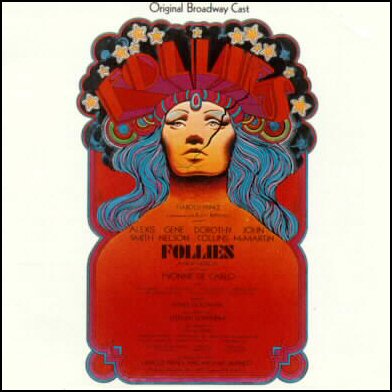 The 1971 cast album produced at
Capitol Records famously did not do justice to the score, dropping entire songs and making significant cuts within those that remained in order to fit the recording on a single LP. With no Best Musical Tony, no movie version, no national tour, and only a truncated recording of the score left behind, despite running for over a year on Broadway and many positive reviews and awards, the musical would remain in relative obscurity in years to come, appearing occasionally in regional or stock productions. The extravagant sets and costumes the property required seemed to be an obstacle for full-scale revivals.
The 1971 cast album produced at
Capitol Records famously did not do justice to the score, dropping entire songs and making significant cuts within those that remained in order to fit the recording on a single LP. With no Best Musical Tony, no movie version, no national tour, and only a truncated recording of the score left behind, despite running for over a year on Broadway and many positive reviews and awards, the musical would remain in relative obscurity in years to come, appearing occasionally in regional or stock productions. The extravagant sets and costumes the property required seemed to be an obstacle for full-scale revivals.Two major productions in the 1980s put Follies back on the map, and also capitalized on the somewhat mythic quality the show had taken on.
 An all-star concert staging with the New York Philharmonic in 1985 resulted in a two-disc recording of the score, in an attempt to correct Capitol's error with its truncated one-LP recording of the original production. With minimal staging and minimal lines of connective dialogue between songs, the concert was also the focus of a documentary film, which included backstage stories about putting the concert together and highlights of the final concert staging. Frank Rich, in his New York Times review of the concert, praised all elements of the presentation, but concluded that the concert was whetting the appetite for a new fully staged production of the musical, which at that time, other than a brief Equity Theatre Library showing in 1976, had not been seen in New York for fifteen years and had yet to have its West End premiere.
Two years later, Cameron Mackintosh, who had produced Side By Side By Sondheim in the UK in 1976 before becoming one of the biggest names in commercial theatre in the ensuing decade, produced the London premiere of Follies in 1987. Directed by Mike Ockrent, with designs by Maria Bjornson, and featuring choreography of Bob Avian, who had been the long-time collaborator of original Follies co-director and choreographer Michael Bennett, the production was billed, “Follies - A Broadway Legend" though, somewhat ironically, it featured an almost entirely new book and a revised score. After receiving mostly enthusiastic reviews from the London critics upon its opening at the Shaftsbury Theatre in July of 1987, the production went on to win the Olivier for Musical of the Year, (beating out the Old Vic revival of Kiss Me, Kate, which won for both its leading players, and two new musicals from the Donmar Warehouse, Up For Grabs and Blues In the Night). The following February, however, on a visit to London, Frank Rich reviewed the production unfavorably in the New York Times, and talk of a Broadway transfer soon disappeared. One year later, the production announced that contracts were ending for several of the cast members (following some high profile replacements the previous fall), and the production would close in February, 1989, after a total of 644 performances.

After the London production closed, Goldman and Sondheim decided against allowing the revised script and score to be used again, and during the next decade, regional and amateur productions of the musical would revert to the original Broadway script and score.
 In 1998, when the New York-adjacent Paper Mill Playhouse in Millburn, New Jersey, mounted a new production, Goldman revisited his script again for a less radical revision than London had seen. The production featured several recognizable stars, and received widespread publicity. Opening in mid-April, the production ran for six weeks in the spring of 1998. Critical reception was favorable. Ben Brantely raved about it in the New York Times. Many critics noted the possibility that the production would transfer to Broadway, where the show had not been seen since the original production almost thirty years earlier.
 The production did produce a cast recording, even more complete than the 1985 recording had been, including several bonus tracks of the cast performing numbers that had been written and discarded for the show prior to its Broadway opening. However, in early July, six weeks after the production had closed, Michael Riedel reported that the rumored Broadway transfer had been blocked by book writer James Goldman and his wife and business manager, Bobby Goldman. It would take another three years for Follies to eventually end up on Broadway, in an all-new production.
Some of the positive reception that the recent 2011 production recieved may have been in part due to a comparison between the new production, and the first and most recent Broadway revival, The Roundabout's 2001 production, which met with mixed reviews, including a mostly negative one from Brantley in The New York Times. The production also failed to win a single one of the five Tony Awards for which it was nominated (in a year dominated by The Producers and the revival of 42nd Street). Ten years later, the production is remembered mostly for its inadequacies, and the 2011 production compared favorably in many respects including its restored full orchestra versus the Roundabout’s reduction, the more extravagant 2011 costumes in comparison to the Roundabout’s cheap ones, and the vocally talented leads, as opposed to the actors-first leads of British director Matthew Warchus’s “Chekhovian” 2001 production.
 |
| Terri White leads "Who's That Woman?" at the Marquis in 2011 |
Nevertheless, it’s interesting to note some of the positive reviews the Roundabout production did receive. Theatre historian, long-time Follies fan and author of A Chours Line and the Musicals of Michael Bennett, Ken Mandelbaum said....
I found this Follies an abundantly rewarding evening, succeeding in crucial areas where previous revivals of the show have failed. With four fine actors in the leading roles, Warchus has managed to delineate the past and present conflicts of the central couples, along with the show's road-you-didn't-take thematic content, sharply and powerfully. If the small-scale spareness was dictated by the budget, Warchus uses it to his advantage; the simplicity of the design and staging adds to the evening's clarity, and if a sense of opulence has been lost, this Follies is as bleak, dark, and elegiac as it should be....Follies remains an endlessly rich, fascinating work; this production gets the most important things right, and proves to be the most dramatically effective revival I've encountered.
 |
| Carol Woods leads "Who's That Woman?" at the Roundabout in 2001 |
“Follies is one of those musicals that need very strong acting from the lead players, and director Warchus was able to give the work its most significant Personenregie since 1971. One truly understood what was happening among those four people…Truth to tell, and despite some flaws, this was a superb revival.”
 |
| "Waiting For the Girls Upstairs" at the Roundabout in 2001 |
“The Roundabout Follies did not succeed, but then Follies
does not succeed, not in the conventional sense. The work is simply too
smart for its good. While praising the Roundabout production in The New Yorker, Nancy Franklin wrote, ‘It’s possible to think that Follies
is a great show and yet not entirely love it; to think that it’s
invaluable and yet not feel embraced by it. You may walk out of the
theatre feeling a little mixed up inside, as though you had just
received the most unforgettable parting kiss of your life.”
 In Sondheim & Co, Sondheim himself is quoted about David Merrick’s disappointment with Gypsy which seemed a commercial disappointment in comparison to such contemporaneous hits as The Sound of Music. Sondheim points out that shows like Gypsy,
which ultimately tell you something you don’t want to hear, are never
going to enjoy the widespread popularity of shows that tell you
something you do want to hear. Gypsy -- your mother destroys you. Sound of Music
-- you can start out a nun, marry the man of your dreams,
continue to love God, and out-smart the Nazis. Which is a more uplifting
story? And the truth is pretty much all of Sondheim’s shows have
followed Gypsy’s
path. They are often hilarious at points, and often hugely entertaining. And
yet, as John Lahr pointed out in Michael Kantor’s documentary, Broadway: The American Musical,
Sondheim’s world is one where people lose things, where they can’t find
each other or themselves, and ultimately are left with a sense of
confusion or loss or outright tragedy. Even in the face of death,
Rodgers and Hammerstein always managed to find a way to allow their
audiences to walk out of the theatre uplifted and reassured about the
positive things in life.
In Sondheim & Co, Sondheim himself is quoted about David Merrick’s disappointment with Gypsy which seemed a commercial disappointment in comparison to such contemporaneous hits as The Sound of Music. Sondheim points out that shows like Gypsy,
which ultimately tell you something you don’t want to hear, are never
going to enjoy the widespread popularity of shows that tell you
something you do want to hear. Gypsy -- your mother destroys you. Sound of Music
-- you can start out a nun, marry the man of your dreams,
continue to love God, and out-smart the Nazis. Which is a more uplifting
story? And the truth is pretty much all of Sondheim’s shows have
followed Gypsy’s
path. They are often hilarious at points, and often hugely entertaining. And
yet, as John Lahr pointed out in Michael Kantor’s documentary, Broadway: The American Musical,
Sondheim’s world is one where people lose things, where they can’t find
each other or themselves, and ultimately are left with a sense of
confusion or loss or outright tragedy. Even in the face of death,
Rodgers and Hammerstein always managed to find a way to allow their
audiences to walk out of the theatre uplifted and reassured about the
positive things in life.Follies, like most of Sondheim's works, stands in sharp contrast to this mold. It is about lost hopes and middle aged crises, and the four protagonists leave the stage broken, devastated and with possibly even less hope of a happy and fulfilled future than they entered with. Even in its current abridged form, many audience members walk away perplexed and confused. (One amusing anonymous critic on broadwaybox.com headlined a review of the 2011 production “Think League of Their Own meets Sunset Boulevard (minus the good music).”
One of the most common criticisms of the musical throughout its existence has been that its book is not on a par with its score. This has been remarked on by several critics and authors, with many defending Goldman's book and positing that those finding fault with the book were simply responding to the unpleasant truths with which Follies confronts its audience (Joanne Gordon and Ken Mandelbaum are two who have made this argument -- see James Fisher's "Nixon's America & Follies" in Stephen Sondheim: A Casebook, pg 74).
 |
| James Goldman |
Nevertheless, many of the negative notices in 1971 focused on book problems, particularly noting that the bickering of the two central couples was tiresome. In 1987, when Cameron Mackintosh expressed his interest in producing the show for the UK, his impression that the original show was too dark and unhappy ultimately seems to have convinced Goldman and Sondheim that they needed to revise the material and to make it less bleak. The resulting new Follies ran longer on the West End than the original production had run on Broadway, but it did not make a profit, and the revised London script and song-stack has never been used again.
Prior to the premiere of the Paper Mill production in 1998, its director, Robert Johanson discussed the approach that he was taking with Goldman for the newly revised script.
“Jim's perspective is that when they created the show, he and Steve and Hal were all going through midlife crises, so they put a lot of this dark angst into the piece. But everyone was dissatsifed with the end -- 'What were we supposed to come away with from this muiscal?'--and now that they're all in or around their 70s and things are different, they feel that actually you do get through that crisis period and find ways to make the most of your life.”
Goldman passed way after the 1998 production, and the 2001 revival also included further script revisions, many incorporated from the Paper Mill script, but others seemed to indicate other hands at work. In 2007, a concert staging for the Encores! series at New York's City Center featured a script which seemed to be a highly abridged conflation of the original, Roundabout, and Paper Mill texts and it was largely this script that was used for the 2011 production, which also featured a few lines here and there new to the production.
In a surprising move, when PS Classics produced the 2011 recording, producer Tommy Krasker asked the creative team to reinstate some of the original dialogue that had been cut or changed over the years for the recording, and some of these changes were later incorporated into the stage production (many weeks after its opening).
Follies has continued to be plagued with criticisms about its book upon each of its major appearances. In 2011, for instance, The New York Times complained about "some of Goldman's more tedious 'smart' dialogue," Newsday referred to "mawkish dialogue," Variety stated that the the show was "somewhat hampered by Goldman's moody book," and The NY Daily News claimed the show "still doesn't quite work, for the simple reason that James Goldman's book never makes us care about these drab characters and their marital fates." It is somewhat ironic that a book which has undergone such constant revision throughout its history would continue to fail to win the approval of the critics. It is difficult not to wonder what critics might make of the show today were they to hear the original book. Though many failed to find it an overall success in 1971, it is not difficult to imagine that forty years later, that original book might seem to solve some of the problems its later revisions did not.
If Follies is meeting with an overall more favorable critical response today than it did in 1971, it seems possible that this is at least in part because of the changing perspectives more specifically related to the work itself than larger global concerns. In 1971, Hal Prince and Stephen Sondheim had only one collaboration behind them, Company -- which like Follies, divided critics but was nevertheless seen as something of a breakthrough for the genre of musicals by many. Today however, Sondheim enjoys a reputation as the greatest living writer of musicals, and one of the greatest of all time. The composer-lyricist actually created a self-mocking song in 2010 called “God” in response to an article in New York Magazine which asked, “Is Stephen Sondheim God?”
Perceptions change over time. In his review of the 2011 production, John Simon, who had panned the show in 1971 had this to say:
[Follies] was so much ahead of its time at its 1971 premiere that most of us critics were left behind. Since then it has had enough American and British stagings for all of us to recognize and revel in its greatness.
Ultimately, Follies in 2011 met with a reaction which seems to continue the tradition of a show that is fascinating to many, meriting much critical thought and response, and yet ultimately does not quite find a large commercial audience. Much ink has been spilled over the years considering what may or may not be the most problematic elements of various productions and where each has failed and succeeded. Today, new productions generally suffer the fate of being unfavorably compared with the original production which can never be re-created -- partly because the budget would have to be astronomical, but also, and perhaps more importantly, because it was completely of its moment. The work is largely concerned with looking into the past, using "showbiz" history as a metaphor. It is a meta-work, and the original company was made up of stars whose own theatrical backgrounds, like the theatrical setting itself, would have evoked a specific era in the memories of some audience members. Today, new productions must be set in 1971 and we must imagine what it might have been like not only to see a performer like Ethel Shutta, an actress who had actually performed in the Zeigfeld Follies, but to experience what looking back on thirty years would have felt like in 1971 versus today. Perhaps the changing perspective of time has ultimately allowed a deeper appreciation of this work, but I believe Follies will always continue to divide audiences.


No comments:
Post a Comment