 When the musical stage version of Victor Hugo's 1862 novel, Les Misérables had its English-language premiere in 1985, its original French title was retained. This was carrying on a tradition of English-language translations and adaptations of the novel, including Hollywood film versions from 1935 and 1952. The title of Hugo's novel translates roughly as "The Wretched" or "The Poor Ones" or even "The Victims" but in general, the English-speaking world always referred to the property by its original French title. Though after the musical adaptation, the property would often be referred to as the abbreviated "Les Miz."
The original novel is split into five volumes in 365 chapters and over 1,900 pages in the original French. Countless film and television adaptations have appeared over the years, most of which significantly abridge the story in order to work it into a two or three hour playing time, often jettisoning entire characters and subplots. A 1934 French film, clocking in at over 280 minutes, and a 2000 French television version which was originally broadcast in four 100-minute installments, are two of the most complete filmic adaptations of the work.

What would become its best-known adaptation, the musical stage version, had its genesis in the late 1970s. According to Edward Behr's The Complete Book of Les Misérables, Alain Boublil, who would ultimately create the original French lyrics/libretto of the musical Les Miz, initially thought of adapting the property after seeing a London revival of Oliver!, the musical adaptation of the Dickens classic Oliver Twist. The two novels, written within twenty-five years of each other, have many similarities, with the character of the Artful Dodger instantly suggesting Hugo's Gavorche to Boublil. (Coincidentally, it was Cameron Mackintosh's 1977 production of Oliver!, one of the fledgling producer's first commercial successes, which sparked Boublil's interest in a musical Les Misérables.)
 Boublil, who had been a publisher and producer of music beginning in the late 1960s, had previously teamed with composer Claude-Michel Schönberg and a handful of other writers, on a "rock opera" based on the French Revolution. La Revolution Francaise was a success in France as a double-LP concept album in 1973, and had subsequently received a successful staging in Paris. Boublil would later say, "It was a very naive work, but a good draft for Les Miserables."
La Revolution Francaise was the result of Boublil's enthusiastic reaction to the Broadway staging of Andrew Lloyd Webber's Jesus Christ Superstar, and following the precedent set by that musical, he and partner Schönberg chose to premiere their rock opera works as concept records, allowing them to focus on the writing and the music prior to dealing with a full staging.

 |
| The 1980 Palais de Sports production |
 |
| The original company of Nicholas Nickleby |
 |
| Caird, Nunn, Mackintosh |
The production which finally premiered at the Barbican on October 8th, 1985 was over three hours in length -- more than an hour longer than the original French production. Initial reviews were mostly negative with many critics accusing the musical of trivialising Hugo. In The Sunday Telegraph, Francis King wrote that "it stands in the same relation to the original as a singing telegram to an epic." Jack Tinker in The Daily Mail famously dubbed the production "The Glums."

Nevertheless, a few critics had found much to admire in the work, and word of mouth for the production was strong. The entire three-month engagement at the Barbican had sold-out and Mackintosh transferred the production to the Palace on the West End, where it is still playing today, over twenty-seven years later.
The American premiere of the musical, first seen in a try-out at Washington's Kennedy Center, opened on Broadway already a hit. Reviews were stronger on Broadway than they had been in London, with an especially positive notice from Frank Rich in the New York Times. The production would go on to win eight Tony Awards, and in a reversal of the Oliviers, "The Glums" beat out the Broadway transfer of Me and My Girl for Best Musical, Best Director (shared by Nunn and Caird), and Featured Actress (this time for one of the two London hold-overs, Frances Ruffelle as Eponine). Robert Lindsay did triumph again, however, winning the Best Leading Actor in a Musical Tony over Wilkinson's reprised Valjean and Broadway's Javert, Terrence Mann. The Broadway production would run for sixteen years, and played an additional two years when it returned for a new Broadway engagement in 2006.
Seen in countries all over the world, translated into more than two dozen languages, and presented in two concert stagings on television for both the tenth and twenty-fifth anniversaries, the musical Les Miz has become one of the most well-known and globally recognized musicals of the late twentieth-century.

Casting took place in 2011 and the film went into production in March 2012, opening on December 5th, 2012 in the UK, with a Christmas Day opening planned for the US.
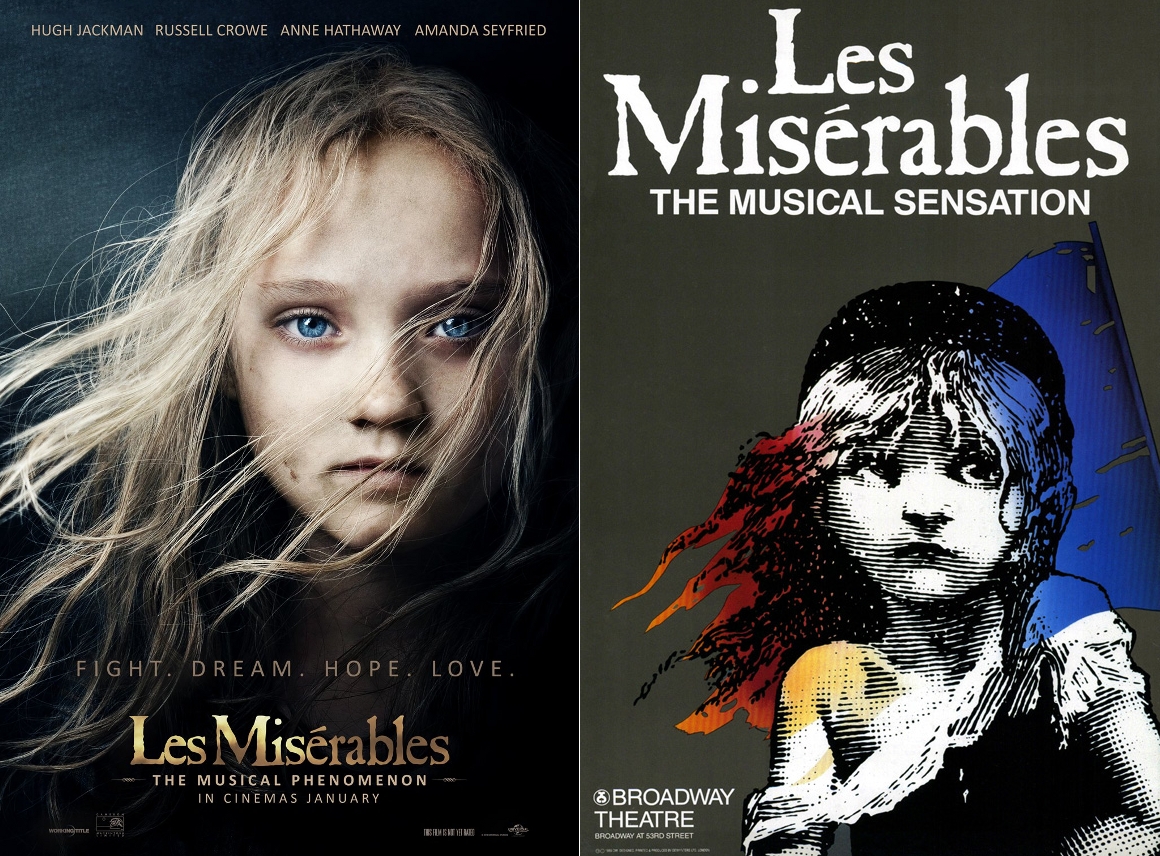
Initial reviews have been mixed, with some critics voicing some of the same concerns about the material that early London critics mentioned, while others focused on their reaction to some of the filmic techniques. RottenTomatoes currently shows 50% Fresh from the Top Critics, though many major outlets are yet to review the movie, with its American debut still days away.
The film has been nominated for four Golden Globe awards, and rumors that Anne Hathaway is a serious Oscar-contender for her portrayal of Fantine are rampant.
While difficult to predict whether or not the movie will repeat the stage show's success, it seems likely to appeal to fans of the show, and make a splash in early weeks of its release.


No comments:
Post a Comment