
Out of the sixteen musicals for which Stephen Sondheim contributed both music and lyrics, only three have been adapted as Hollywood films. Two more, for which Sondheim provided lyrics to another composer's music, have also been adapted to the big screen (and one of those was also adapted for the small screen).

The time in which Sondheim began writing musicals, the late 1950s and early 1960s, was a time in which Hollywood was routinely looking to the Broadway musical as a source material. Early Hollywood musicals in the late 1920s and 1930s were mostly either original creations, or extremely loose adaptations of stage works. However, the revolution that was seen on Broadway in the 1940s via Rodgers and Hammerstein allowed musicals to be taken more seriously, and film adaptations of stage works slowly began to reflect an increased respect for the integrity of the original work. By 1955, when Rodgers and Hammerstein's first musical, Oklahoma! finally made it to the screen, the pair were a revered duo, the Kings of Broadway, and the long-awaited Hollywood premiere of Oklahoma! faithfully reproduced the landmark work for the movies, satisfying its worldwide fans, and respecting the structure and content of the original. This was quickly followed by several more highly faithful film transfers of R&H works-- by 1961, four of their collaborations had been released as Hollywood films, and their final musical, 1959's The Sound of Music would become the most successful of all Broadway-to-Hollywood musicals when it was released in 1965.
The ten years between the films of Oklahoma! and The Sound of Music, largely through the adaptations of R&H works, but also with such major examples as West Side Story, The Music Man, and My Fair Lady, represented a period in which big-budget Hollywood adaptations of Broadway musicals meant both big business, and even a chance to win Oscars. However, following the success of The Sound of Music film, Hollywood produced several big budget failures in the musical genre, and while Oliver! and Funny Girl were successful exceptions, expensive failures, coupled with the changing aesthetics of the decade, contributed to a declining interest in Broadway musicals in Hollywood.
In the 1970s, Hollywood adaptations of Broadway musical hits would become less frequent than in the past. The biggest hit Broadway had in that decade, 1975's A Chorus Line, would take ten years to finally make it to Hollywood, and when it did it was a poorly received bomb. 1978's adaptation of another Broadway hit, The Wiz, would also be a significant failure.
Given the climate of the late 50s and early 60s, it is probably no coincidence that the first three Broadway musicals with which Sondheim was associated, 1957's West Side Story, 1959's Gypsy, and 1962's A Funny Thing Happened on the Way to the Forum, all made it to the movies. All three were fairly successful on Broadway, particularly Forum, but only the 1961 Hollywood West Side Story would be a major box office success.
Sondheim's next two Broadway musicals, the experimental Anyone Can Whistle for which he wrote both music and lyrics, and the more traditional Do I Hear a Waltz?, with music by Richard Rodgers and Sondheim's lyrics, were both flops -- the former running only nine performances, the latter running a more significant 220. Both were therefore unlikely to receive Hollywood treatment, and Waltz had been seen as a non-musical movie less than a decade before.
During the next five years, Sondheim would have no new Broadway musical, but it was during this period that ...Forum made it to the screen, and also during this period, he contributed a short score of songs for a television special, Evening Primrose. Based on a John Collier short story, with a teleplay by Sondheim's future-Follies collaborator James Goldman, the work was created for ABC's "Stage 67," a weekly series which was cancelled after its first season which ran from the fall of 1966, with Evening Primrose premiering in November, to the spring of 1967. The telecast was in color, but the master tapes were either discarded or lost and only black-and-white versions survive. For over forty years, the production was only viewable in branches of the Museum of Television and Film but finally in 2010, a 16 millimeter print was used for a DVD release by E1 Entertainment and the Archive of American Television. The production features four original Sondheim songs (and one reprise). Sondheim also contributed most of the incidental music, orchestrated by Norman Paris, with an additional contribution from David Shire.
By 1970, when Sondheim launched a new stage of his career in conjunction with producer-director Harold Prince, producing five Broadway musicals before the decade's end (plus a musical version of an Aristophanes play for Yale), Hollywood was less interested in musicals. Though 1979's Sweeney Todd would eventually make it to the movies, it would take almost thirty years. The one musical which did make it to the screen within a few years of its Broadway premiere, was 1973's A Little Night Music, which came to the screen in 1977.

On Broadway, Sondheim's musicals in the 1970s did not make money. However, as producer, Prince had been able to keep the shows running long enough to overcome often tepid reviews from first-night critics and allowed the seriousness and depth that the musicals were achieving to be appreciated. Of the five Broadway musicals of the 1970s, Sondheim would win Tonys for the scores of all but 1976's Pacific Overtures (which lost out to the juggernaut, A Chorus Line).
Hollywood produced successful adaptations of 60s musical hits Fiddler on the Roof and Cabaret in the early 1970s, but bombs such as Song of Norway, On a Clear Day You Can See Forever, and Mame, did not bode well for the future of Broadway-to-Hollywood musical translations. In the last years of the decade, only 1978's Grease, would make a major Hollywood hit out of a Broadway musical.

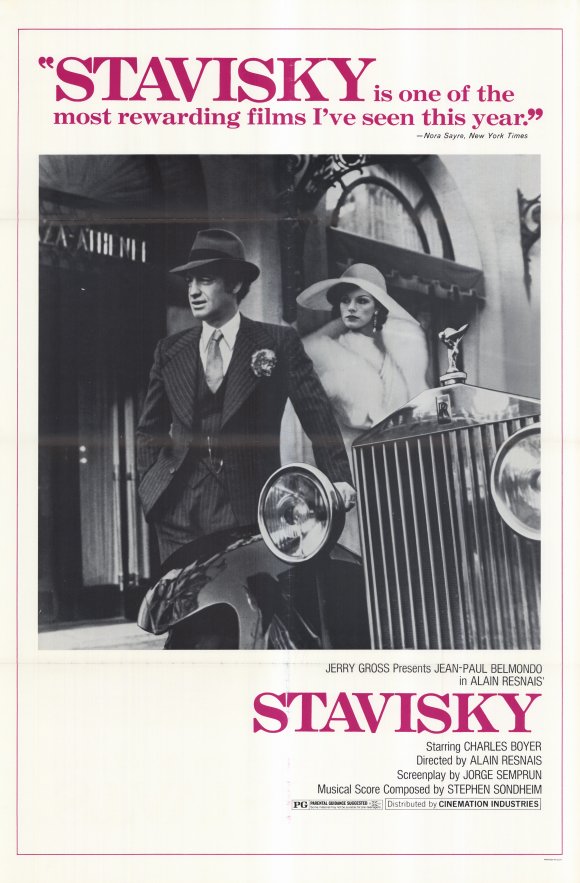
"I knew all Sondheim’s music, but the deeper I got into the Stavisky, the more I knew his music was perfect…. To give you an idea how important Sondheim’s music was to me, when writing the shooting script I conceived certain key scenes rhythmically, in terms of his music. And on the first day of shooting, I had my tape recorder handy, with key passages of A Little Night Music constantly in my ear, to make sure that the rhythm of the scene coincided with Sondheim’s music. That involved the speed with which the actors walked, Baron Raoul’s gestures, the whole scene with the white airplane outside Biarritz."In 1976, Sondheim was again approached by Herbert Ross, who had gotten him involved with The Last of Sheila, to write a song for his film adaptation of Nicholas Meyer's Sherlock Holmes novel, The Seven Percent Solution. In one scene, Holmes visits a brothel, where the Madam is heard singing the suggestive "I Never Do Anything Twice." Only an excerpt from the song is heard in the finished film, but it would be more widely heard in its complete form when it was included in Side By Side By Sondheim, a revue of the composer's material seen in London in 1976 (the same year the movie was released) and the following year on Broadway.
Sondheim would again be convinced to contribute music for a film score, though for Warren Beatty's Reds, unlike Stavisky, the composer declined to write the entire film score, but he agreed with the filmmaker's approval to create a simple melody which would recur throughout the movie as the love theme. Sondheim eventually added a lyric to the melody and the song became known as "Goodbye For Now". Perry Como made an early recording of the song in 1981.
Over the next decade, Sondheim would have little to do with the movies, though he remained active on Broadway, and it was also during this period that Sondheim's stage musicals would begin regularly being captured on video for commercial release. Sondheim's 1976 Broadway experiment, Pacific Overtures, had been videotaped live at the Winter Garden, but was only shown on Japanese television. However, it was Sondheim's next Broadway project after Pacific Overtures which would be widely seen on the small screen.

In March of 1979, along with long-time collaborator, director-producer Harold Prince and book writer Hugh Wheeler, Sondheim premiered Sweeney Todd on Broadway. The production received mixed to positive reviews, and went on to win seven Tony Awards and continued its Broadway run through June of 1980. The following month, a short-lived London production opened at the Theatre Royal Drury Lane. In October, the first national tour was launched in Washington, D.C. with Broadway star Angela Lansbury recreating her Tony-winning role alongside co-star George Hearn, who had replaced original star Len Cariou in the New York production. For the tour, the physical production was scaled down from the mammoth original, and it was this version that came to be preserved on videotape in the summer of 1981 at the Dorothy Chandler Pavilion in Los Angeles, during its final weeks. (A second national tour starring June Havoc and Ross Petty would launch the following February).
In the early 1980s, there were a number of platforms for theatre to be seen on television with Great Performances, American Playhouse, HBO's Standing Room Only, and Broadway on Showtime each offering several television editions of theatre works. Some were actual filmed stage productions, while others were theatre works filmed in a television studio. RCA's short-lived premium cable venture The Entertainment Channel lasted only nine months, but it was here, as a special pay-per-view event, that Sweeney Todd premiered on television in September of 1982. It would be repeated on Showtime a year and a half later, and was seen on Great
Performances in 1985 and subsequently released on home video, with DVD releases in 2004 and 2008.
The next two Sondheim shows which had their New York premieres after Sweeney's TV bow, Sunday in the Park With George and Into the Woods, were both collaborations with director/book writer James Lapine, and were also videotaped for broadcast. Unlike Sweeney, these were seen in their original Broadway stagings with almost all of their original casts in tact. Sunday premiered on Broadway on Showtime in February of 1986, the television production directed by TV's Terry Hughes, who had also helmed the Sweeney taping. The production would be broadcast on American Playhouse later the same year, while Into the Woods premiered on American Playhouse in 1991, this time with Lapine handling the TV direction himself.
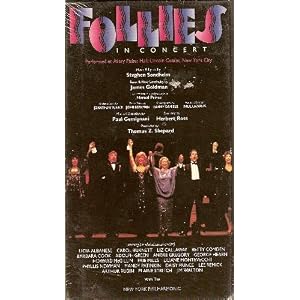
Also during this period, a major concert staging of Sondheim's 1971 work, Follies, was presented at Lincoln Center's Avery Fisher Hall with the New York Philharmonic and stars including Barbara Cook and Lee Remick. The purpose of the concert, in addition to benefiting the Philharmonic and the Dramatists Guild Young Playwrights Festival, was to provide an opportunity of recording the full score of the musical, which had only received a truncated recording at Capitol upon its Broadway premiere. In addition to the recording. EMK Productions produced a documentary about the staging of of the concert. Directed Michael Houldey and produced by Ellen M. Krass, the program would be broadcast as part of Great Performances in March, 1986.
Though Sondheim's controversial off-Broadway collaboration with John Weidman, Assassins, was not taped, his final musical to play Broadway, Passion, which returned Sondheim to collaboration with Lapine, was filmed shortly after closing on Broadway, premiering on television via American Playhouse in September of 1996. Putting It Together, a Sondheim revue which had begun life in the UK in the early 90s, and had been seen Off-Broadway in 1993 with Julie Andrews as the star, made its way to Broadway in 1999 as a vehicle of Carol Burnett. This production was also taped and shown as a simultaneous movie-theatre and pay-per-view cable event on October 14, 2001 with subsequent home video releases.
Additional Sondheim works which have been seen on the small screen in more limited distribution include two "Live From Lincoln Center" broadcasts, 1990's New York City Opera production of A Little Night Music, and a 2005 concert production of Passion at Rose Hall, as well as a 1996 Donmar Warehouse production of Company, which was broadcast only in the UK via BBC 2 in March of 1997.
Company would be seen in home formats twice more, the first being a filming of the 2006 Broadway revival, and second, a concert staging with an all-star cast performed with the New York Philharmonic in the spring of 2011. The concert screening was filmed and shown in movie theatres as part of an initiative which has been gaining traction in recent years of broadcasting theatrical (and in some cases, live) performances in movie theatres. Though the "cinecast" of Company was not shown live, it premiered only three months after the concert, but would not be released in home format for over a year.
While the majority of Sondheim's Broadway works in the last thirty years have been preserved on the small screen, Sondheim's next film work after Reds was a full decade later, and was once again in collaboration with Warren Beatty, who asked the composer to create songs for his big-screen version of the 1940s comic strip, Dick Tracy. Sondheim would ultimately contribute five songs to the film, which was not a musical, but featured Madonna as "Breathless Mahoney," a nightclub singer who sang two of Sondheim's songs in the film, one of which earned Sondheim an Oscar.
Sondheim would again be asked to provide a few songs for another non-musical movie, this time a new film adaptation of La Cage Aux Folles, which had been musicalized for the stage in the early 1980s. Mike Nichols' 1996 film, The Birdcage (a rough translation of the French title) was not a film version of the stage musical, but instead an adaptation of the original French film (itself based on a French stage work). However, the story about owners of a nightclub once again required songs for the performer characters to sing, and Sondheim obliged with two new songs, only one of which ended up being used in the final film (and that, only heard in snippets). However, two existing Sondheim songs, both songs which had been cut from the shows for which they were written, were used. ("Can That Boy Foxtrot," which was replaced in Follies by "I'm Still Here" and "Love Is In the Air" which was replaced by "Comedy Tonight" in Forum).
Two unproduced film works which would have included Sondheim material had they made it through development were collaborations with William Goldman, brother of James Goldman, Sondheim's collaborator on Follies and Evening Primrose. The first was for a proposed screen adaptation of Goldman's 1967 novel, The Thing Of It Is. Though a non-musical film, Goldman's screenplay called for one song which would be heard repeatedly throughout the film. Sondheim wrote the song, "No, Mary Ann" for the unproduced film in 1969. The other William Goldman project did not begin development for over twenty years, but would have been a much larger project. To have been directed by Rob Reiner, Singing Out Loud was an original musical movie about the making of a musical movie. Sondheim wrote several songs for Goldman's screenplay. Though some of the songs were later recorded, the movie never made it out of the development stage. Sondheim detailed how each of the songs would have worked in the context of the screenplay in the second volume of his collected lyric books, Look I Made a Hat.
Film adaptations of Sondheim musicals have been rumored as in development many times over the years.
A film Into the Woods with a screenplay by Lowell Ganz and Babaloo Mandel was developed with Jim Henson Productions in the 1990s, and the film was to have featured creatures from Henson's studio. Attached to various production companies, readings of the film script were held featuring all-star casts. (See the Muppet wiki for various names attached to the project over time). Sondheim had written new material for the Henson production, which never materialized. However in late 2012, it was announced that Rob Marshall was developing a new film adaptation of the piece, and currently the rumor is that Meryl Streep will star as The Witch.
The Marshall-helmed film adaptation of Chicago, another stage musical which had been in development as a movie for years before finally getting the greenlight for Marshall's production, was a surprise hit in 2002 and paved the way for a resurgence of film musicals in the 2000s. Though various film musicals, including adaptations of stage works, had been produced in the 80s and 90s, few had been successful, and the genre, as a whole had been largely dormant up to that time. However, producers Craig Zadan and Neil Meron had been responsible, in the 1990s, for beginning a new trend of television musical productions, several of them adaptations of classic stage works such as Gypsy, Bye Bye Birdie, Rodgers & Hammerstein's Cinderella, South Pacific, and The Music Man. For 1999's television remake of Annie for The Wonderful World of Disney (following a flop film adaptation in the early 1980s), Marshall was given his first screen directing project. Chicago, his first film, was not only a surprise success, but won the Oscar as Best Picture, and in the following decade, several movie musicals were produced, including Marshall's less-successful adaptation of Nine.
In 2007, a film version of Sweeney Todd was produced. Another project which had been in development for years, at one time, rumors of a Sam Mendes-helmed production to star Russell Crowe and Imelda Staunton had circulated. But it was Tim Burton who ultimately made the film, with two of his perennial stars, Johnny Depp and Helena Bonham Carter (the latter also the director's wife).
The screenplay by Gladiator scribe John Logan had introduced a conceit of Todd's ghosts appearing throughout the film to sing the title ballad which runs throughout the musical, but this element was ultimately cut before the production went in front of the cameras. However the rest of the score was used almost completely in tact, and Sondheim made many public comments praising the film. The film was only moderately successful at the box office and with critics.
2008's film version of the stage hit Mamma Mia was only mildly successful in the US, but did excellent business worldwide, and this year's film treatment of Les Misérables has done strong business and is nominated for several Oscars, perhaps aiding to fuel the momentum for the potential Into the Woods film (which is also helped by Marhsall's recent directorial stint on the latest Pirates of the Caribbean film, a major hit).
To date, while only three of Sondheim's stage musicals have been produced as movies, coupled with the several TV/video captures of stage productions, approximately half of Sondheim's musicals are commercially available for home viewing.
Among those that remain without video representation, two shows, Anyone Can Whistle and Merrily We Roll Along were both flops on stage, and unlikely to see video productions (though both have been recorded multiple times and future stagings could potentially be filmed for posterity). Assassins, though not a true flop in the sense that Merrily and Whistle were, was only seen initially in a very limited engagement at Playwrights Horizons and did not transfer to a commercial run. The non-profit Roundabout Theatre Company's 2004 revival was critically acclaimed, but closed after its brief, limited run.
Road Show, the composer's last musical, titled variously Wise Guys, Gold, and Bounce, prior to its current title, was given its first full production in 2003 (as Bounce) after many years of development, in a production that played Chicago and Washington but did not make it to New York. Finally the musical was produced by The Public Theatre and played a limited engagement there in 2008, followed by a brief run in London. Though cast recordings of both Bounce and Road Show were produced, a video/film version seems highly unlikely.
Pacific Overtures, though not available commercially, has had two Japanese television showings, both the original Broadway production filmed in 1976, and a 2000 Japanese language production.
This leaves Follies, the landmark 1971 musical which has been revived on Broadway twice, but as of this writing can only be seen in glimpses in the behind-the-scenes documentary of the 1985 Avery Fisher Concert production, which features limited highlights from the concert performances. Other than that, no commercial video has been produced of any production of the show.
There was some Hollywood interest in a film version of Follies in the early 1970s. Publicist John Springer worked to put together a package for 20th Century Fox with stars such as Elizabeth Taylor, Bette Davis, and Joan Crawford. Harold Prince had also envisioned a movie version of Follies, this time for MGM. Prince described the concept:
There was going to be a movie version, and I was going to do it at MGM. My idea was to make it about movies and about the last night of MGM, because you could see that that was actually happening. I said, "Why don't we get every movie star in Hollywood to come for this party? I'll give the party, and we'll talk to the stars about theater." Joan Crawford wanted to sing "Broadway Baby," and Bette Davis wanted to sing "I'm Still Here." We had all that lined up and I said, "If all the other people, the Lana Turners and Dorothy Lamours, come, we'll pay them a stipend and give all the money to charity." All of that was put in the pipline, and MGM did That's Entertainment instead because it was cheaper.
Rumors of a Follies film have circulated again in recent years, particularly after a successful concert staging was seen at New York's City Center in 2007, with rumors of Sam Mendes as the director and with Aaron Sorkin attached as a screenwriter, but particularly after the lack of major success for the Sweeney film, the project appears to have stalled. The recent stage production which played the Kennedy Center and Broadway in 2011 followed by a brief stint in Los Angeles in the summer of 2012 went unfilmed, and another major production in New York is unlikely for some time, so we will most likely continue to live without a film or video version of Follies for several more years to come.
It seems natural that at some point, the most revered writer of musicals will eventually see more of his works adapted as movies, but as a writer whose works are challenging and divisive, the risky venture of making a musical film will always deter studios and executives.


No comments:
Post a Comment